
The New Cold War: How U.S.–China Rivalry Is Redrawing Global Alliances
Explore how the U.S.–China rivalry is reshaping global trade, technology, and alliances in a new era of geopolitical tension and economic decoupling.
Related: BRICS Expansion and the Global Economy | AI and the New Rules of Power
The New Cold War: How U.S.–China Rivalry Is Redrawing Global Alliances
A strategic investor’s take on how supply chains, semiconductors, energy routes, and finance—not ideology—now define global power.
I. Introduction — A Cold War Without the Ideology
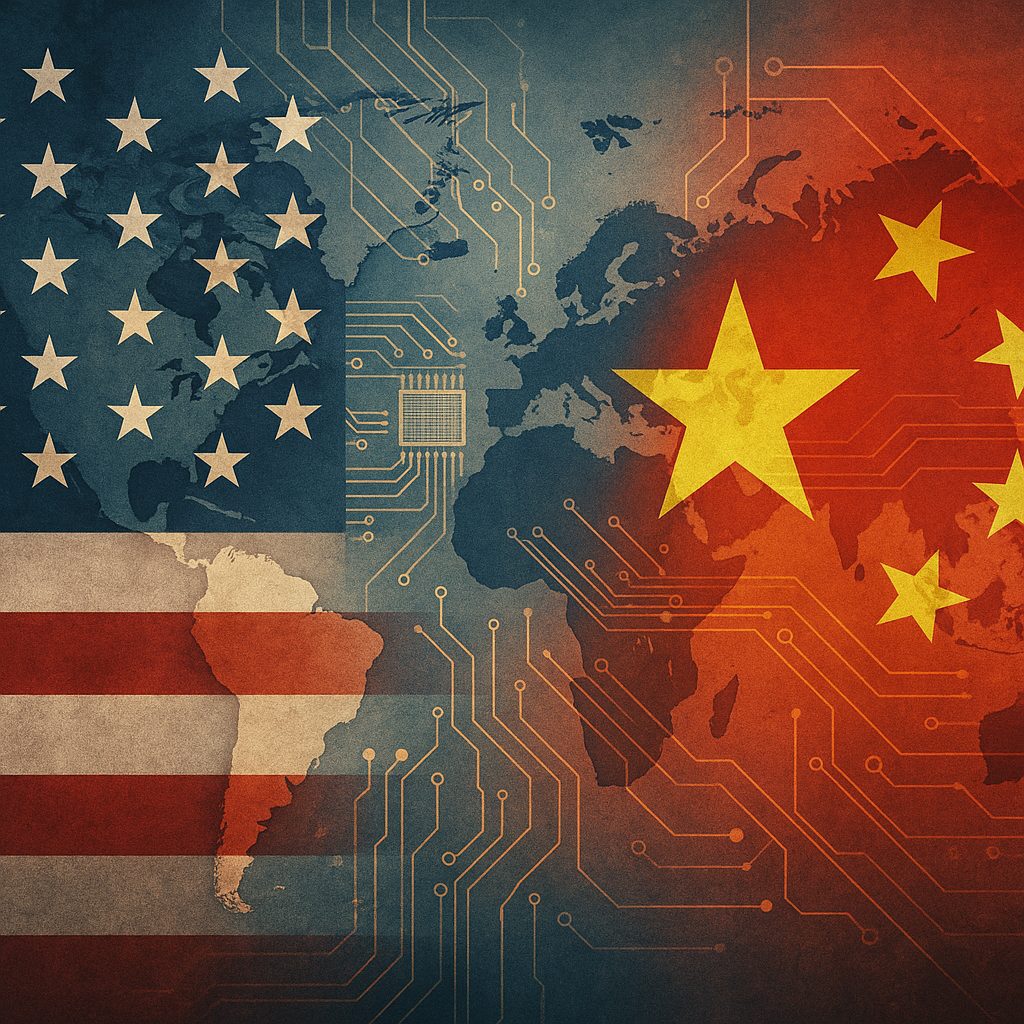
A new global conflict is unfolding quietly—not fought with ideology or missiles, but with microchips, energy routes, and financial networks. The rivalry between the United States and China has become the defining axis of world politics.
Unlike the 20th-century Cold War, this confrontation doesn’t divide the world into “capitalists versus communists.” It divides nations by how deeply they’re wired into each superpower’s economic and technological systems. Supply chains, semiconductors, rare-earth minerals, and digital infrastructure are today’s front lines.
In Washington, the playbook is “containment without confrontation”: pressure China through export controls, sanctions, and alliances rather than open war. In Beijing, the approach is “integration through dominance”: tie nations to Chinese capital and logistics so deeply that economic dependence becomes deterrence. Both sides have learned the same lesson—the dollar and the chip are stronger weapons than the tank.
II. Economic Decoupling — Trade, Tech, and Financial Systems
The Great Decoupling Has Begun
For decades, globalization promised efficiency. Today, it’s being unwound by security. The U.S. no longer views China as an indispensable factory—it sees it as a systemic rival. Export controls on advanced semiconductors, bans on U.S. tech investment in China, and tariffs across strategic sectors all mark the shift from integration to insulation.
The semiconductor war is the sharpest example. The U.S. has blocked China’s access to advanced chips and to the Dutch company ASML’s lithography machines, essential for producing leading-edge processors. In response, China has poured billions into domestic chips, achieving limited breakthroughs but remaining several generations behind.
Meanwhile, manufacturers are diversifying. Vietnam, India, and Mexico are absorbing production once destined for China. This “China+1” strategy doesn’t eliminate China—it reduces exposure. The ripple effect extends to commodities: China dominates refining of lithium, cobalt, and rare earths for EVs and renewables. Western nations now race to onshore critical-mineral processing, a years-long, subsidy-heavy effort.
Financial Bifurcation
Below the surface, financial decoupling is accelerating. The weaponization of the U.S. dollar—freezing Russian reserves, cutting adversaries off SWIFT—has made many emerging economies uneasy. Beijing’s answer is CIPS, its interbank payment system, plus the digital renminbi (e-CNY) that could bypass Western clearing.
While the dollar remains dominant, the trend is clear: the global economy is splitting into two partially connected systems. In one, transactions clear in dollars under U.S. oversight. In the other, China offers loans, trade settlement, and technology with fewer political strings attached. The globalization that made China rich is evolving into geo-economics that defines who holds power.
III. Military Realignment — Deterrence in the Indo-Pacific
The Return of Forward Defense
Every economic wall eventually needs a military fence. The U.S. strategy in the Indo-Pacific mirrors early Cold War containment—only now the geography is maritime.
- AUKUS (Australia, U.K., U.S.) will supply nuclear-powered submarines to Canberra.
- The QUAD (U.S., Japan, India, Australia) expands joint naval patrols and interoperability.
- New base access in the Philippines and Micronesia forms a 270-degree arc around the South China Sea.
Beijing responds with massive naval expansion and an “anti-access/area denial” doctrine—long-range missiles, hypersonics, and cyber capabilities aimed at keeping U.S. forces at bay.
Taiwan as the Tripwire
Taiwan produces a majority of the world’s semiconductors, including the most advanced chips. For Beijing, reunification is identity. For Washington, Taiwan’s autonomy anchors Pacific security and technological supremacy. Both sides practice deterrence: China with encirclement drills; the U.S. with arms sales and training. The greater risk is accidental escalation—a mid-air collision or naval standoff that spirals.
The Regional Arms Race
Japan is remilitarizing after decades of pacifism; South Korea debates its own nuclear deterrent. Even ASEAN states—Philippines, Vietnam—are tightening security ties with Washington while maintaining trade with China. The Indo-Pacific has become what Europe was in the 1950s: a test of great-power credibility.
IV. Emerging Alliances — BRICS+, the Gulf, and the Hedge Strategy
Multipolarity in Motion
While Washington and Beijing compete, the rest of the world plays both sides. The BRICS bloc has expanded to include major oil powers. Their unifying goal isn’t ideology but autonomy from Western financial control. De-dollarization is less about replacing the dollar than reducing vulnerability to it.
Energy Diplomacy Replaces Military Blocs
In the Middle East, U.S. monopoly influence is over. Saudi Arabia sells more crude to Asia than to the West. Iran is reintegrating via China’s mediation and BRICS links. The UAE buys Western defense systems while funding Chinese infrastructure. Power is shifting from ideological alignment to transactional balancing; Gulf monarchies act as market makers in geopolitics.
Latin America and Africa’s Transactional Neutrality
Latin America hedges: Chinese banks finance infrastructure; U.S. and European capital chase lithium and agriculture. Across Africa, Belt and Road ports and rails coexist with Western critical-mineral partnerships. The Global South is now the swing vote in the world’s power balance.
V. Europe and the Global South — Neutrality as Strategy
Europe’s Strategic Dilemma
Europe’s reliance on U.S. security and (historically) Russian energy created a contradiction. The Ukraine war forced a reset: cutting Moscow meant higher costs and deeper reliance on Washington. Eastern Europe presses for hard deterrence; Paris and Berlin explore “strategic autonomy.” The continent splits between Atlanticists and Autonomists.
Multi-Alignment in the South
India, Turkey, Brazil, Indonesia aren’t choosing sides—they’re choosing options. Discounted Russian energy, Chinese infrastructure, Western markets. IMF/World Bank conditionality is countered by China’s AIIB and regional lenders. The result: a parallel development ecosystem that sidelines Western influence without open confrontation. Neutrality has become a power strategy.
VI. The Outlook — AI, Energy, and the New Rules of Power
Technology as Deterrent
AI, quantum, and data control are the nuclear weapons of the digital age. The U.S. leads in frontier chips and models; China wields a centralized data advantage at population scale. The next phase of rivalry will be fought less on carrier decks and more in data centers.
The Energy Transition Arms Race
The green transition adds a fresh layer of competition. EV batteries, hydrogen, and critical minerals are geopolitical instruments. The U.S. subsidizes clean tech at home; China dominates inputs and mid-stream processing. Resource holders—from Chile to the Congo—sit in the new crossfire.
Capital Markets as Battlefields
Finance is now a weapon. The freezing of Russian assets set a precedent; sovereign wealth funds and central banks are rethinking jurisdiction risk. Simultaneously, U.S. scrutiny of outbound investment constrains Chinese access to critical technology. We are approaching a financial Cold War in which capital flows are constrained by trust more than price.
VII. Conclusion — Navigating the Age of Multipolar Risk
The New Cold War is not ideological—it’s transactional, permanent, and structural. It won’t end with a treaty because it lives inside the systems powering modern life. Globalization is no longer neutral; every supply lane, software license, and clearing network now carries geopolitical weight.
Winners will master adaptability: diversified supply chains, flexible capital routes, and trusted data regimes. “Swing-state” markets—India, Indonesia, Mexico, Saudi Arabia—will command premiums. The U.S. must sustain leadership without overextension; China must scale dominance without provoking a balancing coalition. Everyone else will monetize the gap.
From a financial lens, power rests on three pillars:
- Data — intelligence sovereignty.
- Energy — industrial independence.
- Trust — the scarce collateral underwriting finance and alliances.
The New Cold War is already here. The task isn’t to predict a winner, but to adapt fast enough to survive—and profit from—the volatility it creates.